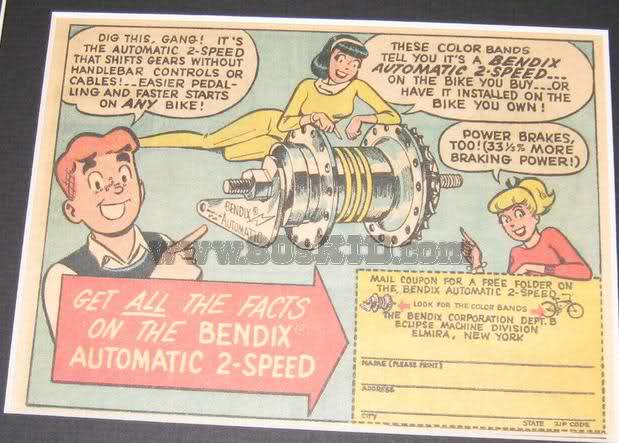
A small selection of vintage bicycle ads.




 The N/E corner of Dundas and Spadina in 1921, the home of Dr. Moorehead will soon be demolished to make way for the Standard Theatre.
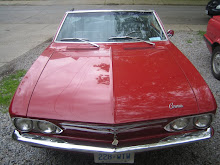
 Looking north across Dundas sometime in the late 1960's. The car in the foreground is a post 1965 Corvair. The Victory Theatre, formerly The Standard Theatre opened in 1921 and was one of the finest Yiddish theatres in North America. In 1935 it was renamed The Strand and re-opened as a movie house and was again renamed The Victory after the war. It continued to operate as a burlesque house until 1975.
 Long associated with Mad magazine, Alfred E. Neuman or the "What, Me Worry?" kid has been around since the early 1900's or earlier. Collectors are still on the hunt for more images. Below is a selection of vintage postcards and advertisements depicting the kid .


 A rare female version.


 Even this image from Coney Island's Steeplechase Park bears some resemblance...
 Christie and Follis in the summer of 1915. Workers repair a collapsed roadway.
 The Cowan's Cocoa factory was located at 27 Sterling Road.
 One of their delivery wagons.
 An old advert.
 This vintage box of animal crackers sold recently for over $100.00.
John A. Wood and John Cowan became business partners in 1890 and formed the Cowan Cocoa and Chocolate Company of Toronto Limited. Optimistic that the company would continue to expand, they purchased a four-story factory located on Sterling Road. In 1893, the company name was simplified to the Cowan Company Limited. In order to set apart Cowan chocolate products from their imported competitors, John Cowan adapted the Canadian maple leaf as a brand in 1898. Maple Buds, destined to become one of the Cowan Company’s most popular candies, were developed during this time. By the time of his death in 1908, John Cowan’s company had grown across Canada, advertising and selling its chocolate products from Halifax to Vancouver. Following his death, John Cowan’s son Herbert Norton took over the business and introduced several new products to the market including Medallions and Almond Filbert nut bars.Despite a slow transition from importer to entrepreneur, John Cowan was eventually successful due to his flexibility and his insistence on product quality and purity. He embraced new marketing and advertising techniques and created a Canadian presence in a field previously dominated by foreign imports.
 The S/E corner of Jane and Maaple Leaf Drive in the late 1950's.
 2010.
2010. The north side of Bloor east of Jane in 1936, note the Loblaw Groceterias store.
 2010.
2010. Another vintage Loblaws, location TBD.
 A house fire on the S/E corner of Jane and Queens Drive in the late 1950's.
 The same corner today.

 The intersection of Bloor and Jane in 1943 before the Bloor was widened.
 2010.
2010. Sometime in between.
 Looking north up the South Kingsway to Riverside Drive in 1908 or so.
 2010.
2010. Looking west along Kingston Road across Victoria Park in the fall of 1922.
 A current view.
 A composite.
 Posts
All Comments
Posts
All Comments